
Mandatory Socialization
2XKO’s Arcade-Themed Lobbies

Riot’s new fighting game, 2XKO, is out! Technically, it’s in “Early Access”, but the game is freely available and fully featured. The label is more like an insecure artist issuing caveats that their latest project is still “work in progress” to protect their ego from criticism. That fear is well-founded; the game’s public stats are not great (gtrends, twitch). But I’m not here to bag on 2XKO. I love the game! I’m having a blast playing Ekko, whose time-travelling abilities allow for zany creativity. The game has received widespread praise among fighting game influencers. But unfortunately, it seems like it hasn’t broken out of that niche. At the end of the day, the game is made by fighting gamers for fighting gamers.
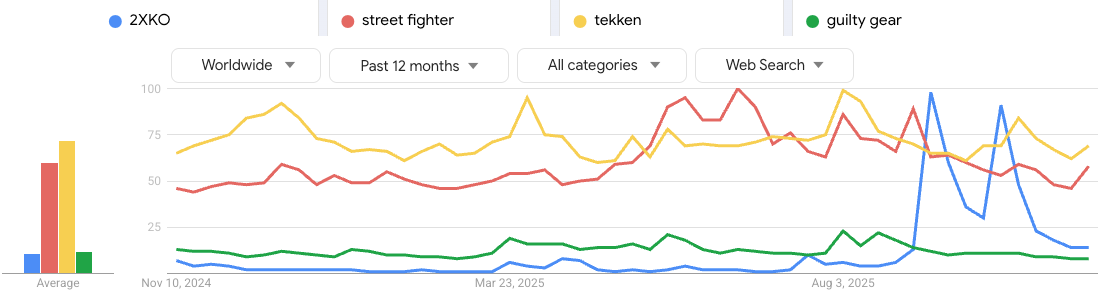
2XKO has some notable non-gameplay deviations from traditional fighters. First is the pricing – free-to-play with cosmetic monetization. 2XKO follows the Riot playbook, likely aiming for broad accessibility and price differentiation. In contrast, premium fighting games have a $60 box price with DLC characters and cosmetics on top. But this isn’t a Brawlhalla situation (the free-to-play smash clone for kids to play on library computers because they don’t own a Nintendo console); 2XKO is the real deal, not a lower-quality substitute. They really need to sell skins.
The lobby system is a major novelty. Matches are found in a (unironic) metaverse lobby rather than an abstract menu. Player-avatars enter a room filled with TVs, arcade cabinets, and other players. To find a match, you need to find an opponent and walk over to a cabinet together. More likely, you’ll press the “Find A Match” button, wait a few moments, and the game will direct you and your assigned opponent to the same cabinet. The latter harkens to the tournament experience, where the organizer will call out your matches (“FireTiger777 and BobbyBigBalls on station 3!”). Between matches, you can wander around, chat with players, and spectate other games.
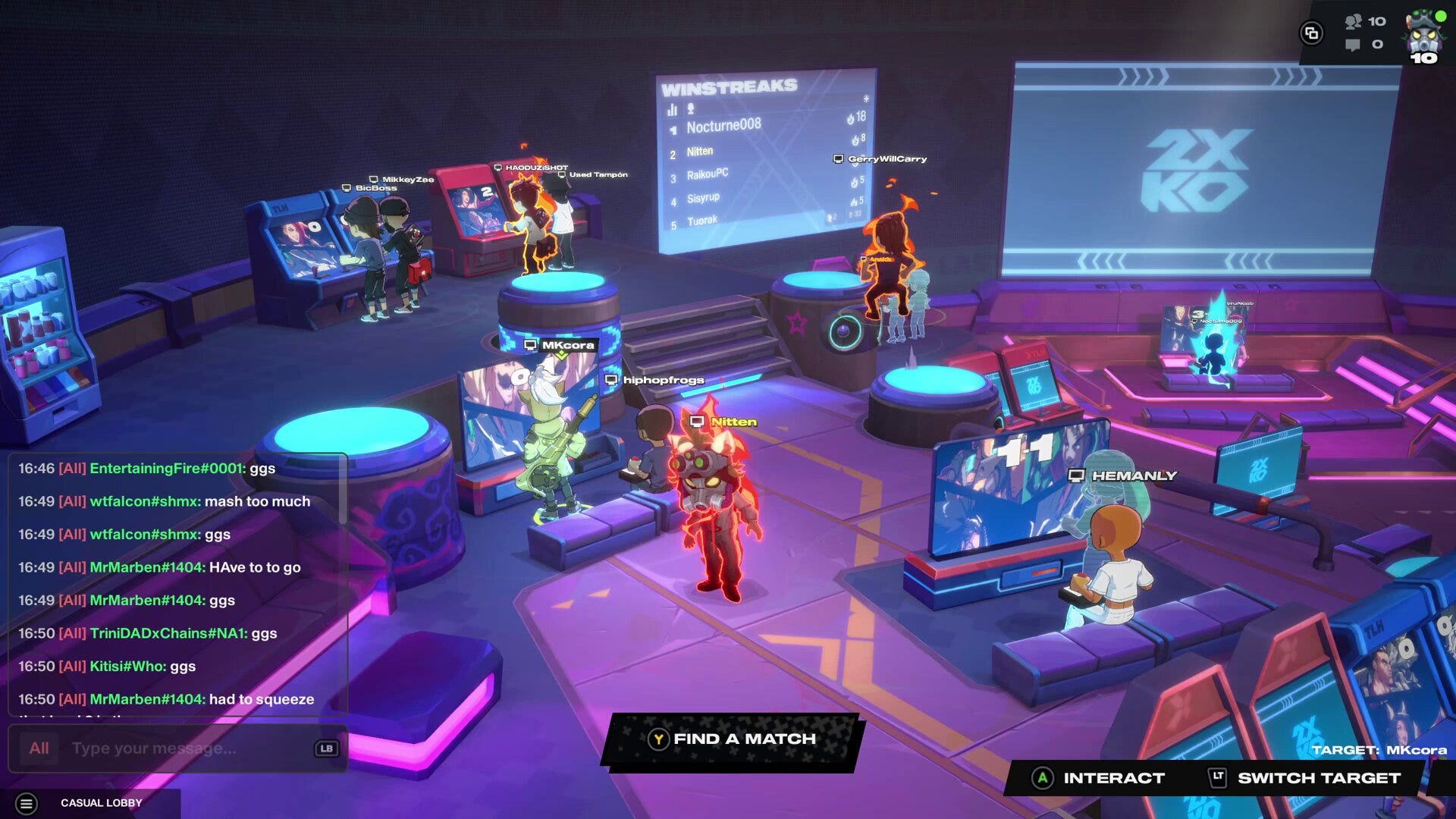
These kinds of avatar-based lobbies are not unique. Guilty Gear pioneered the idea, and Street Fighter 6’s Battle Hub is the most prominent implementation. However, both were quite clunky. Veteran players grew to avoid them, opting to “quick-match” in the startup menu rather than jump thru extra hoops. 2XKO is unique in making these lobbies mandatory. All matches, casual and ranked, are routed through avatar lobbies. Thankfully, 2XKO’s lobbies are the smoothest iteration yet. Load times are quick and finding matches is easy. Spectating is seamless; you simply walk up to a cabinet and a little pop-up window appears to show the match in action without disrupting your avatar’s lobby movement. The UX is fantastic.
Unfortunately, lobbies fail to accomplish their intended effect – socialization. Lobbies are clearly intended to recreate the social atmosphere of heyday arcades: chat up your opponent, spectate a grudge match, try to beat the player on a win streak. But in my dozens of hours of play, I have yet to encounter any meaningful social interaction. Sometimes there’s a “GG” in chat, and occasionally some salty butthurt loser will complain “stop spamming cheap moves noob”. The emphasis on avatars does create additional surface area to sell cosmetics. This has worked out decently for Street Fighter 6’s optional battle hub, so it will likely be more successful in 2XKO’s mandatory lobbies. But that’s about it.
Is it salvageable? I think the root failure is communication. Social dynamics require communication, and 2XKO’s lobbies are lacking. When you send a chat message, it appears off in a corner inside a chat window, instead of over your head. This creates loads of missed messages; one player says “GG” after a game, and their opponent never notices. Spectating would also be enhanced by communication. A load of hooting and hollering will gather a crowd, but some silent avatars won’t. Emote options are also limited. Players can equip up to 5 emotes, but there is only one available by default. No doubt, 2XKO is making the mistake of imitating LoL’s (weak) emote monetization. I think the best version of lobby socialization would be enabled with proximity voice chat. Allow players to chat seamlessly after their games, hear the commotion of a crowd watching an exciting match, or ask for advice from your sparring partner. Default-on voice chat is the richest form of communication you’ll get in an online video game. It does come with the risk of harmful interactions, such as verbal abuse, but that’s part of human socialization. If 2XKO isn’t wiling to commit to socialization, they might as well revert to quick match.
2XKO’s lobby system is obviously inspired by arcades, but it applies far more broadly than fighting games. This kind of shared lobby is common in cooperative games like Helldivers or Monster Hunter, but a rarity in competitive games. 2XKO-style lobbies could certainly exist for Hearthstone or Counter-Strike, where player-avatars wander around a card shop or gaming cafe. But they don’t. I have several weak theories to explain why. Perhaps cooperative players want to socialize and interact, while competitors are focused on their next match. Perhaps cooperative games allow for more group persistence, while competitive games naturally rotate players between opponents. Or, perhaps fighting game developers are guided by misplaced nostalgia, yearning for the days when fighting games dominated the social gaming landscape and trying to recreate their treasured childhood memories. Perhaps fighters, like real-time strategy, need to accept their place in the new world order as an established but niche genre, kept alive by enthusiasts but never again breaking into mainstream pop culture.