
2games1app
Teamfight Tactics inside of LoL

Three major drafting autobattlers are embedded inside other games; Teamfight Tactics inside LoL, Battlegrounds inside Hearthstone, and Merge Tactics (formerly “Clash Mini”) inside Clash Royale. It’s a peculiar pattern.
Usually, bundled games fall into one of three categories:
Bundles, like NYT Puzzles, Jackbox Party, or UFO 50. These games are usually light, casual or arcade-y. The individual games are difficult to sell on their own.
Alternate modes on the same game engine, such as CoD Zombies or MtG drafts. These are spin-offs that reuse core systems like gameplay mechanics, UI, and progression.
User-generated content, such as Fortnite Creative or WC3 custom maps.
But the aforementioned autobattlers are none of the above. They are full-bodied first-party games, with a distinct genre from their host game. Moreover, this phenomenon seems rare outside of autobattlers. Is it something specific to this genre? I’ll try to explain away this peculiarity with three points: Marketing, Tech, and Shenanigans.
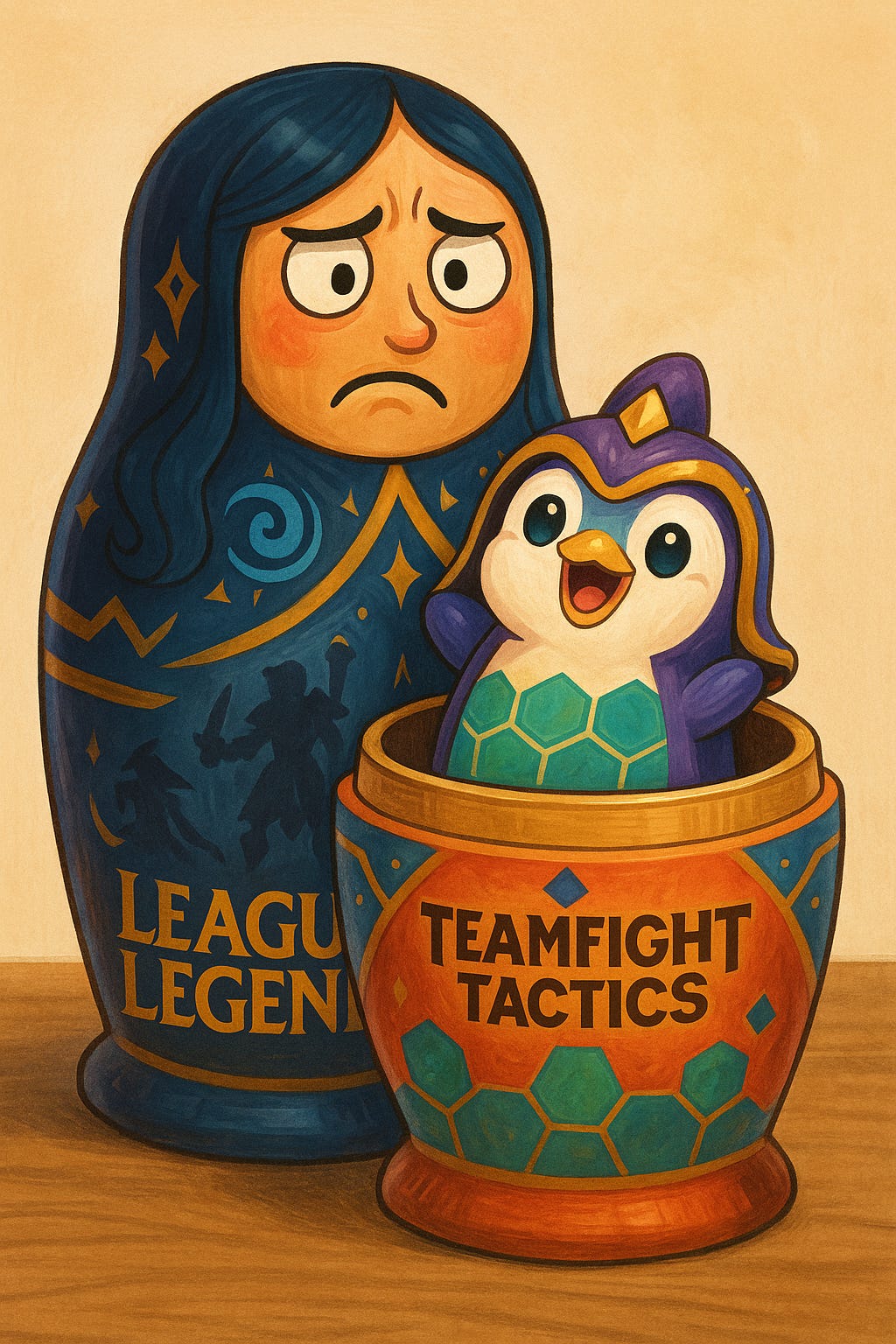
From a marketing perspective, bundling games together seems to raise their floor but lower their ceiling. The tacked-on game gains low-friction access to the host’s playebase, but its brand is tightly coupled with the host game and can’t develop a strong distinct identity. Autobattlers, as a niche new genre, did not have a large public audience. Instead, it seemed easier to acquire users by attaching to an established, popular, strategy-adjacent host game (LoL, Hearthstone, and Clash Royale). The autobattlers also fill a complimentary niche for LoL and Clash Royale; turn-based rather than realtime, and different game length (shorter than a LoL game, faster than a Clash Royale game). However, autobattlers also monetize poorly, so they may not be financially successful as a standalone game. Instead, they keep players in the orbit of the better-monetizing host game.
Technical constraints are another benefit. While the tacked-on autobattlers offer different gameplay, they reuse a lot of assets from the host game. Art, audio, gameplay mechanics, etc. can be recycled, and out-of-game social and progression systems can be shared. The autobattler can be bundled into the host game’s executable without too much bloat.
Idiosyncratic shenanigans are also at play. In 2019, China began routing all new game approvals through their dystopian-sounding Ministry of Culture. Ostensibly, they were checking for harmful moral themes or dissident political messages in games. In practice, this restricted foreign games’ access to the Chinese market and gave leg up to well-connected insiders. Around the same time, Teamfight Tactics was being developed inside the LoL engine. In a crafty way to circumvent the approval process, TFT was launched inside LoL, not as a separate game, and was one of the few new foreign releases in 2019. Moreover, there was internal political tension at Riot over “game 2” (as in, what game would follow LoL). It was a political quagmire, and TFT managed to sidestep it by developing inside of LoL. Hearthstone Battlegrounds likely has a similar story.
Clash Mini (aka Clash Royale’s Merge Tactics) had similarly unusual circumstances. Clash Mini soft launched as a standalone game but struggled to gain traction. Likely a mix of weak retention and low monetization meant that the game seemed unfeasible as a standalone product. However, it’s still content; might as well try to use it. So supercell shoehorned Clash Mini inside of Clash Royale as an alternate mode. It’s possible there was a bit of “monkey see, monkey do” in copying TFT and Battlegrounds’ model.
Where are they now?
Of the three, TFT is doing the best. It managed to find its footing and has begun growing 6 years after launch (a rarity in modern live services), with an active twitch scene and two mobile adaptations. Clash Mini seems to basically be a non-factor. It does exist as an alternate mode, but adoption is extremely low; within my 50-person clan, only 13 of them have even tried the mode, and I’m the only one to have played more than 5 games in it. Battlegrounds is a big uncertainty to me. It is quite popular, and has absorbed a decent chunk of the core Hearthstone playerbase. So, as a game, it’s doing much better than Clash Mini. However, Battlegrounds monetizes much worse than base Hearthstone; there’s hardly anything to buy, and there’s far less pay-for-power. It’s not obvious if Battlegrounds has net increased or decreased Hearthstone’s revenue.